University of Miami Debate Team continues to shine
During the 2025 season, the University of Miami Debate Team brought home three top prizes, along with many other distinctions.
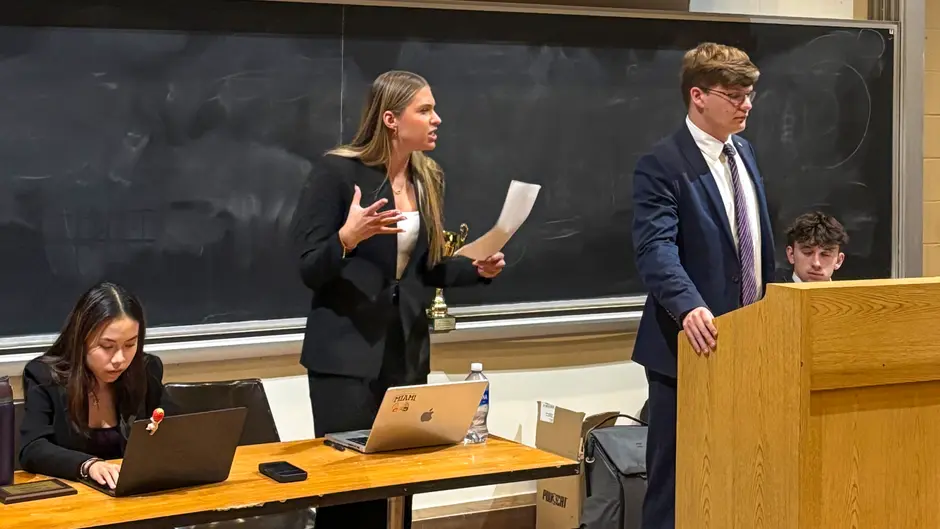
From left: First year students and debate team members Olivia Pisinski and Ping Areeanchuleekorn face off against another debate team in the Rochester Civic Debate tournament, where they made it to the finals. Photos courtesy of the University of Miami Debate team.
By Barbara Gutierrez
1-9-2026
This story originally appeared in News@TheU.
The University of Miami Debate Team finished 2025 with another stellar performance.
It continued to build on its tradition of competitive excellence as members participated in 10 debate competitions, advancing to the finals of five and winning three, affording the University’s teams the distinction of having no team with a losing record at a competition.
Twenty-eight Miami debaters participated in intercollegiate debate competitions, many of them new to debate, said David Steinberg, associate professor of professional practice and director of debate. University of Miami student debaters won a total of 17 individual awards.
“Our program opens the door to students who have had no previous experience in debate and offers those with experience opportunities to refine their skills and give back to their teammates,” said Steinberg. “We do more to provide an educational experience that is new and fresh than most other programs do.”
Steinberg credits the team’s success to the great camaraderie and dedication of many of the student leaders. One of them is Paulina Barnjak, a sophomore who had no experience in debate but admits that the program and her fellow debaters gave her the skills that have made her a better public speaker and writer. Many of the topics she tackles in debate turn into stories for The Miami Hurricane, the University’s award-winning student newspaper.
“Debate is a wonderful way to improve our public speaking skills but also have fun and work in a team atmosphere,” said Barnjak, who is the president of the debate team’s executive board. She and her fellow executive board members lead the debaters in weekly prep sessions. On average, students spend 10 hours a week preparing for a tournament, she said.

From left: Yolanda Del Pino, Sydney Harrison, Joseph Theisen, Jack Gonzalez, Sukai Truxal, and Clarisse Coelho.
The preparation pays off. The team gathered three first place awards during the year. Some of the most significant competitions included:
- The Ronald Reagan and Pepperdine Debate Invitational hosted by Pepperdine University, where students debated one-on-one on the motion of “The Abolition of the U.S. Department Would Be A Beneficial Policy for Higher Education.” Barnjak and Dylan Long, a junior, participated. Long was named the final winner.
- Yolanda Del Pino, a first-year student, and Japheth Oyedepo, a junior, under the direction of lecturer and assistant director of debate Patrick Waldinger, competed online in the Novice Division of the Public Policy Debate tournament hosted by University of Minnesota. The topic was labor and collective bargaining. They made it to the finals. Policy debate is one of the most rigorous forms of debate since it takes intense research and preparation, said Steinberg.
- Social Justice Civic Debates, University of Rochester. The team of first-year students Ping Areeanchuleekorn and Olivia Pisinski advanced to the finals. They discussed voting rights, debating both sides of the resolution that voting rights should be constitutionalized by positively affirming the right to vote through constitutional amendment.
“What I am most proud of is not only the awards and competitions we won,” said Steinberg, “but it is the number of people that participated, learned, and grew from their experience in debate, and the number of people who we introduced to the life-changing experience offered by debate.”
He is also proud that the students were introduced and became knowledgeable on three types of debate forms: parliamentary, policy, and civic debate. Each format offers its own distinct learning opportunities, with different ways of delivering arguments, different circuits and networks, and different approaches to preparation and presentation.
For Del Pino, debate has been a gift that has taught her how to become a better speaker and be able to fine tune her critical thinking skills.
“Debate has been an experience that has taught me skills—like how to better articulate myself—which have positively impacted my life,” she said.