How Dr. Kallia turns her journey into a voice for others
The new University of Miami student chapter of the National Association of Hispanic Journalists is the first in the University’s history.

By Claire Millisor
At four years old, Dr. Kallia Wright was already a regular in the nurses’ lounge. Born and raised in Jamaica, Dr. Wright spent afternoons sitting in the nurses’ lounge where her mother worked. Those hours, filled with coloring books and rhythms of the hospital, inspired her interest in health communication. These formative experiences inspired both her doctoral studies in Intercultural and Health Communication and her ongoing research into patients’ voices, health disparities and maternal health.
Originally Dr. Wright planned to be a medical doctor. In high school, she was known among her family as the “bright cousin”, the one destined for medicine. After taking physics and chemistry, she decided she was meant for a different path. Throughout her childhood, her father instilled a nightly ritual of watching the 7 p.m. news, which was mandatory. “At the time, I thought this was the most boring thing,” she recalls. “But now looking back it is what sparked my interest in journalism.”
That ritual led her to study journalism at the University of the West Indies, where she learned not only how to tell stories, but how to value them. She later discovered health communication with the help of her professors in graduate school, allowing her to merge both of her interests.
Today, Dr. Wright is an Assistant Professor and researcher at the School of Communication, a field that has merged her love for healthcare, media and advocacy.
Her work highlights the stories of patients who struggle to be understood or believed. Dr. Wright advocates for patients to be heard, “If someone has taken the time to come to an appointment, they didn’t wake up bored. They’ve driven to you, waited for you–listen to their stories.” This philosophy guides her classroom teachings. She uses personal narratives to bring credibility to course concepts and make them more understandable.
In the classroom, Dr. Wright shares her own personal narrative to connect with her students, her story of living with endometriosis. Despite advocating for herself, she was initially dismissed by medical professionals, ultimately discovering her diagnosis through her own research on WebMD and the internet. Her experience teaches students about invisible illness and the importance of self-advocacy.
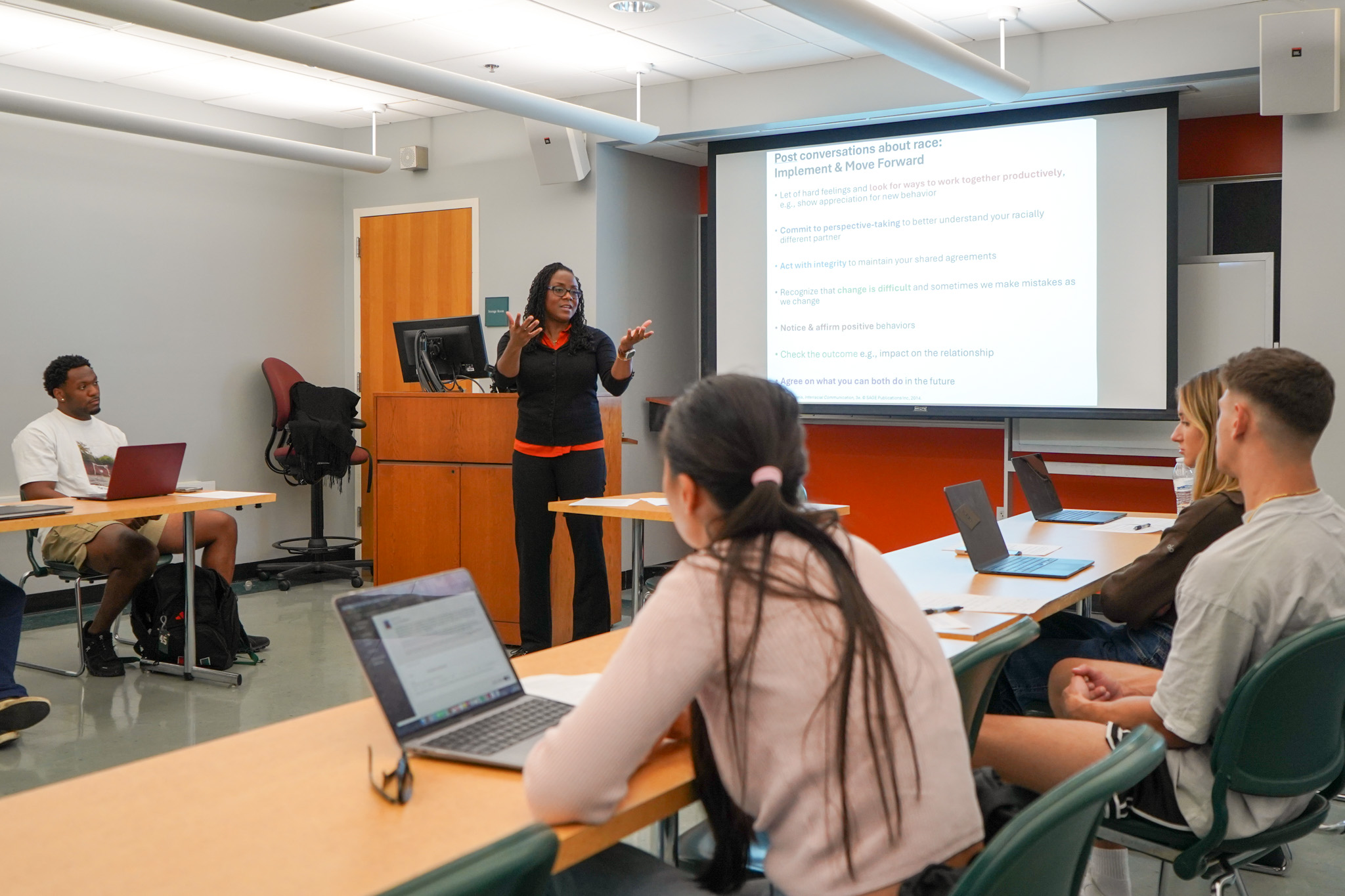
“You are an active participant in your healthcare,” she tells her classes. “Your voice matters in the decision-making process.”
But she also ensures students leave with empathy for practitioners, explaining the systematic pressures they face, including short-staffing, insurance barriers and high caseloads.
Dr. Wright takes pride in the growth of the students she mentors, especially graduate students. She remembers a first-year graduate student who told her, “I’m so nervous because I’m supposed to teach and I’ve never taught in my entire life.” To build her confidence, Dr. Wright invited her to shadow her Communication Theory class and deliver three lectures throughout the semester.
Two years later, the student returned and said, “Dr. Wright, I’m now teaching the Communication Theory class by myself.” Dr. Wright smiles telling this story. “Watching students gain confidence is one of the most rewarding parts of the job.”
Today, Dr. Wright’s work focuses on the experiences of black women navigating health care systems, focusing on maternal health and endometriosis. She is currently working with the Miller School of Medicine alongside Dr. Matthew Schlumbrecht, M.D., to study the awareness of endometrial cancer among African-American and Black Caribbean women.
From a nurses’ lounge in Jamaica to the classrooms of the University of Miami, Dr. Wright continues to show students that communication isn’t just an academic field, but a tool for advocacy and change.