M.F.A. capstones redefine the space between technology and human connection
Six Interactive Media capstones explore how thoughtful design and emerging technology can deepen relationships, support well‑being, and create more meaningful digital experiences.

By Bella Armstrong
At a time when technology shapes nearly every aspect of daily life, the question of how we design digital tools that still feel human has never been more important. In the Department of Interactive Media at the University of Miami, that question is no longer theoretical — it’s the driving force behind this year’s M.F.A. capstone projects.
This year, each student’s work examines the relationship between people and technology through a different lens, transforming complex ideas into interactive experiences that invite reflection, play, empathy and connection. From immersive environments to games to assistive tools, these projects showcase how thoughtful design and commitment can bridge the gap between innovation and humanity.
What follows is a closer look at the six capstones, each offering its own vision for how technology can shape — and strengthen — the ways we communicate, create, and understand one another.
2gether while apart
With a background in mental health and play therapy, Justin Jacobson wanted to use interactive media to strengthen bonds between parents and children.
“I wanted to focus on something in that area that uses play and interactive media to build a relationship between parents and kids,” Jacobson said. “We narrowed it down to an area where media would be most beneficial, and what we landed on was when parents and kids can’t be together.”
When families are separated—due to military deployments, custody disputes, or work—a disconnect can form. While video calls help, Jacobson explained that bonding happens best through play. “There are a lot of attachment challenges that arise because they’re not able to interact in the ways they normally would,” he said.
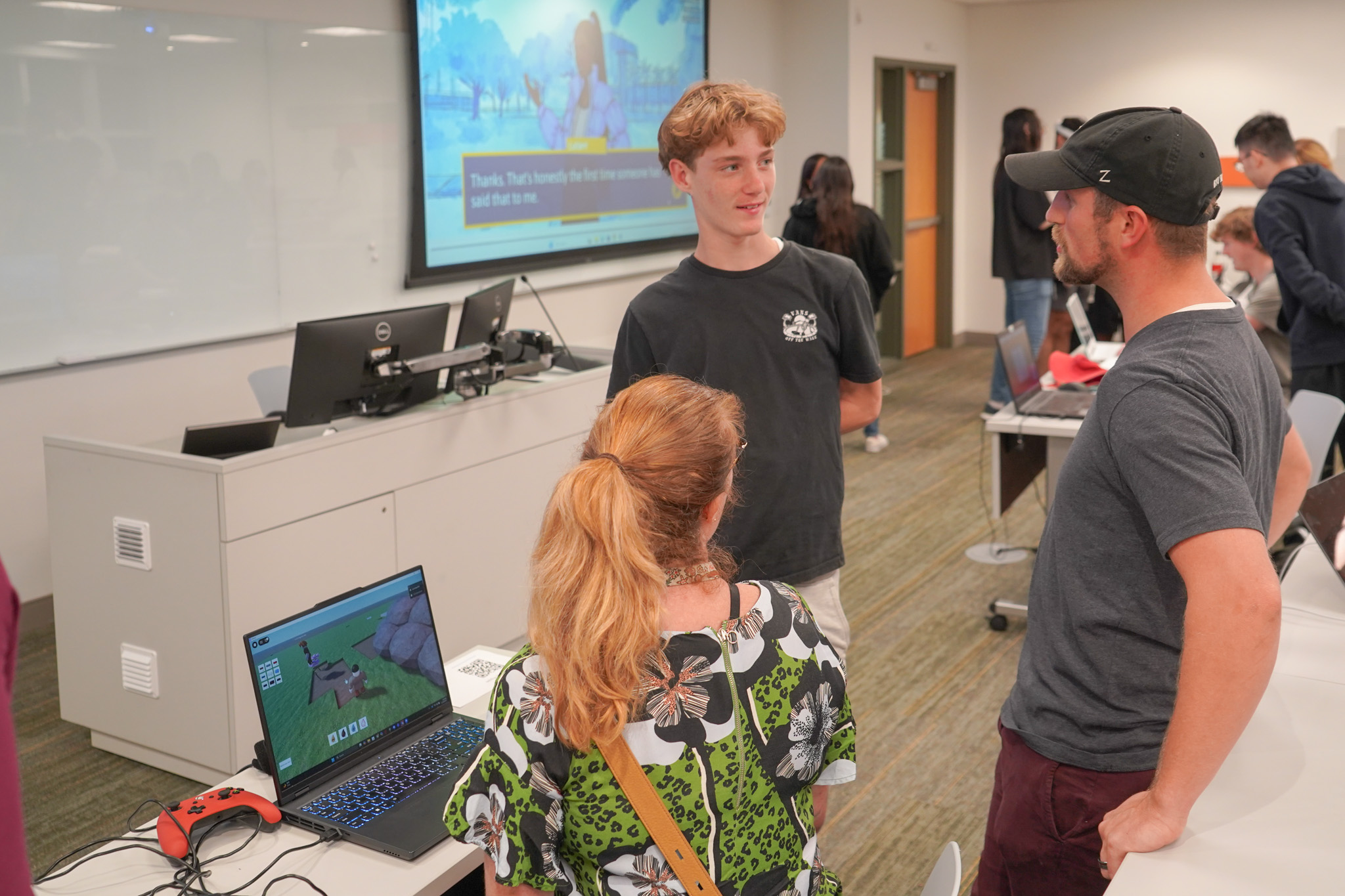
Jacobson’s project, 2gether, is a multiplayer game within the Roblox ecosystem designed to bridge that gap. In the game, parents and children can complete cooperative challenges, explore interactive worlds, and engage in playful activities that mirror the kinds of interactions they would have in person.
Coding an ally
Today, artificial intelligence is at the center of an often-technologically pessimistic argument. But for Ma’at Hetep, technology — and AI — has the ability to help more than to do harm.
She’s designing an AI-centered app to help triage and support homeless women and mothers in shelters, providing them with guidance, resources, and emotional support tailored to their unique circumstances.
Her app will have an AI agent she refers to as “an ally,” specifically designed for homeless women and mothers in shelters. “Through a lot of my research, homeless people don’t have people to talk to,” she said. “Whether they are isolated because of the situation, or self-isolation out of embarrassment or not wanting to be a burden, they tend to turn inward, which may lead to self-harm.”
Hetep is also directly involved in coding and training the AI to respond empathetically and appropriately. “I wanted to make sure the technology is as human-like as possible,” she said. Because it’s not just about giving information to a computer for data entry — it’s about listening, understanding, and guiding someone toward help in a safe way. “Technology is a tool. [We] can use it for good,” Hetep said.
Generational gaming for good
Matt Liff has noticed a growing disconnect between generations, and he believes that connection through gaming could help bridge that gap. His project—a three-player action-adventure game—draws inspiration from retro classics while incorporating modern mechanics to create a shared experience for players of all ages.
“When I initially started, my idea was about how I could create games that people my age, who have kids, could find games that they could both enjoy,” Liff said. “But how can I make that a multiplayer experience?”
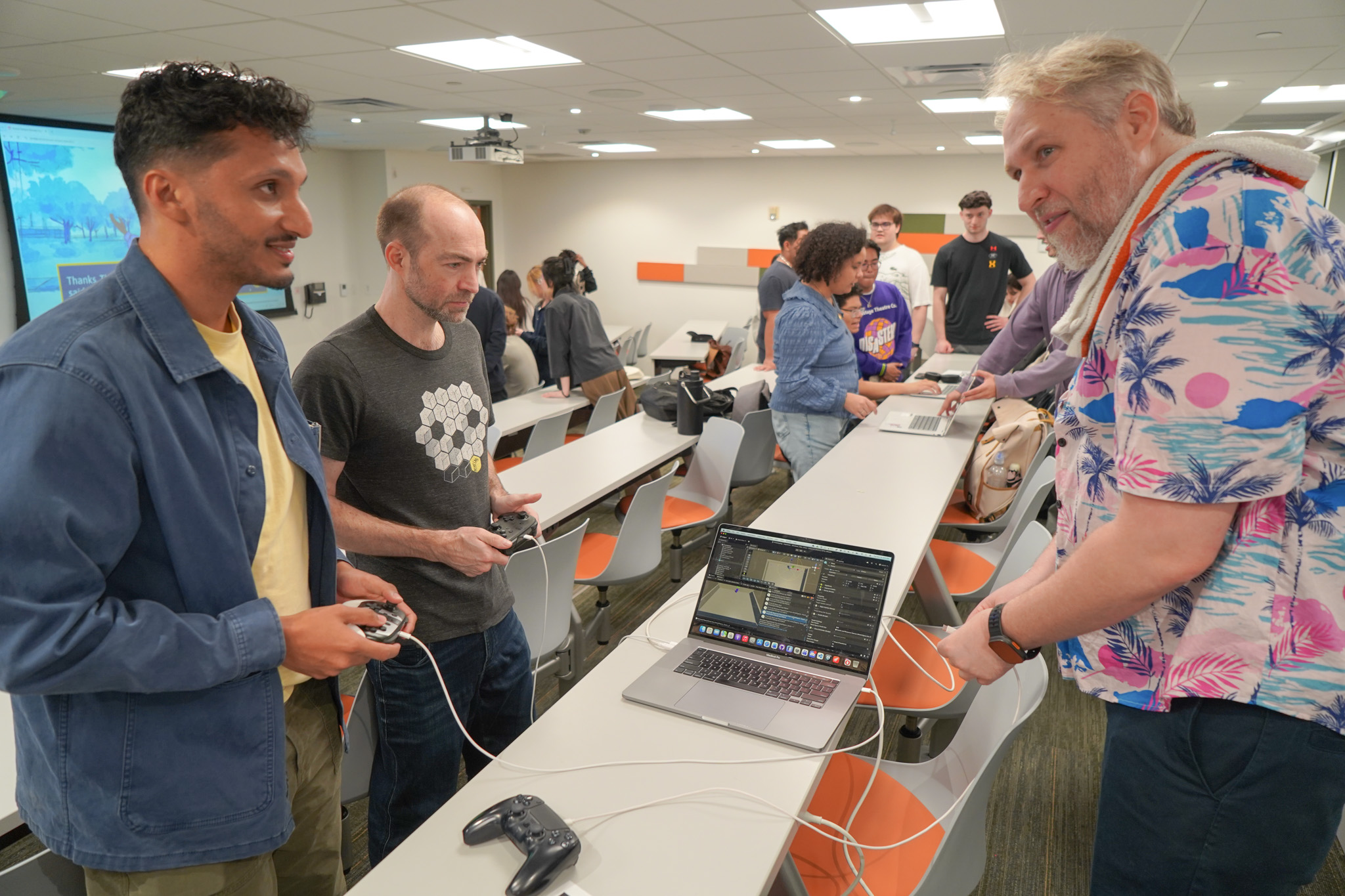
The idea grew rapidly from there. His model follows the classic RPG format, with a protection class, a damage class, and a support class—each player contributing unique skills to overcome challenges, solve puzzles, and progress through the story together. This structure not only encourages teamwork but also ensures that every player, regardless of age or gaming experience, can find a meaningful role in the adventure.
By encouraging collaboration, problem-solving, and storytelling, Liff aims to foster meaningful interactions between younger and older generations, proving that games can be more than entertainment—they can be a tool for connection.
Handheld couples therapy
What if couples were provided a chance to work out their problems in a low-risk, comfortable environment for a few minutes a day? That’s the question M.F.A. student Paulina Fiore asked herself when designing her project.
“So many married couples get divorced,” Paulina Fiore explained. “The number one cause of divorce is a lack of communication.”
“I think we can fix that.”
Her app provides couples with shared prompts, tasks and goals to help strengthen their connection, communication, and most importantly, their relationship. She believes that this app can be used prior to and during marriage to help address high divorce rates.
The goal isn’t to replace traditional therapy or counseling but to make communication feel less intimidating and more accessible. By turning reflection and conversation into bite-sized, daily habits, Fiore hopes couples will build emotional resilience long before problems grow into crises.
2D ninjas educate players today
M.F.A. student Yifan Xu wanted to merge two passions: a long-standing fascination with ninjas and a deep love for gaming and game design. His capstone project became the perfect intersection.
To ensure authenticity, Xu spent hours researching traditional weapons, movement mechanics, and the lesser-known truths of ninja history. The result is a game where every detail — from the tools used to the way a character vaults across a roof — is rooted in careful scholarship rather than Hollywood myth.
“Overall, I’m very interested in Asian culture and fact-based games,” Xu said. “Also, there aren’t a lot of 2D ninja games.”
The scarcity makes the project stand out even more, offering a refreshing alternative to the often exaggerated portrayals of ninjas that dominate Western media. Through engaging gameplay and clean, classic design, Xu hopes to challenge misconceptions and encourage players to see Asian culture and Japanese history through a more informed lens.
Concerts are for everyone — even those not in attendance
Imagine attending a concert you’re not even at — the music, the energy, the collective rush of experiencing something extraordinary with your friends — all from the comfort of your own home. It sounds unbelievable, almost futuristic.
But for Jane Yao, it’s not only possible — it may be the next evolution in how we experience live events.
“Ticket prices have gotten so expensive. It’s harder to get tickets, especially for young people,” Yao explained. “For people that have to stay home or have physical disabilities or [are] hospitalized, we want to carry on the live concert experience to them.”
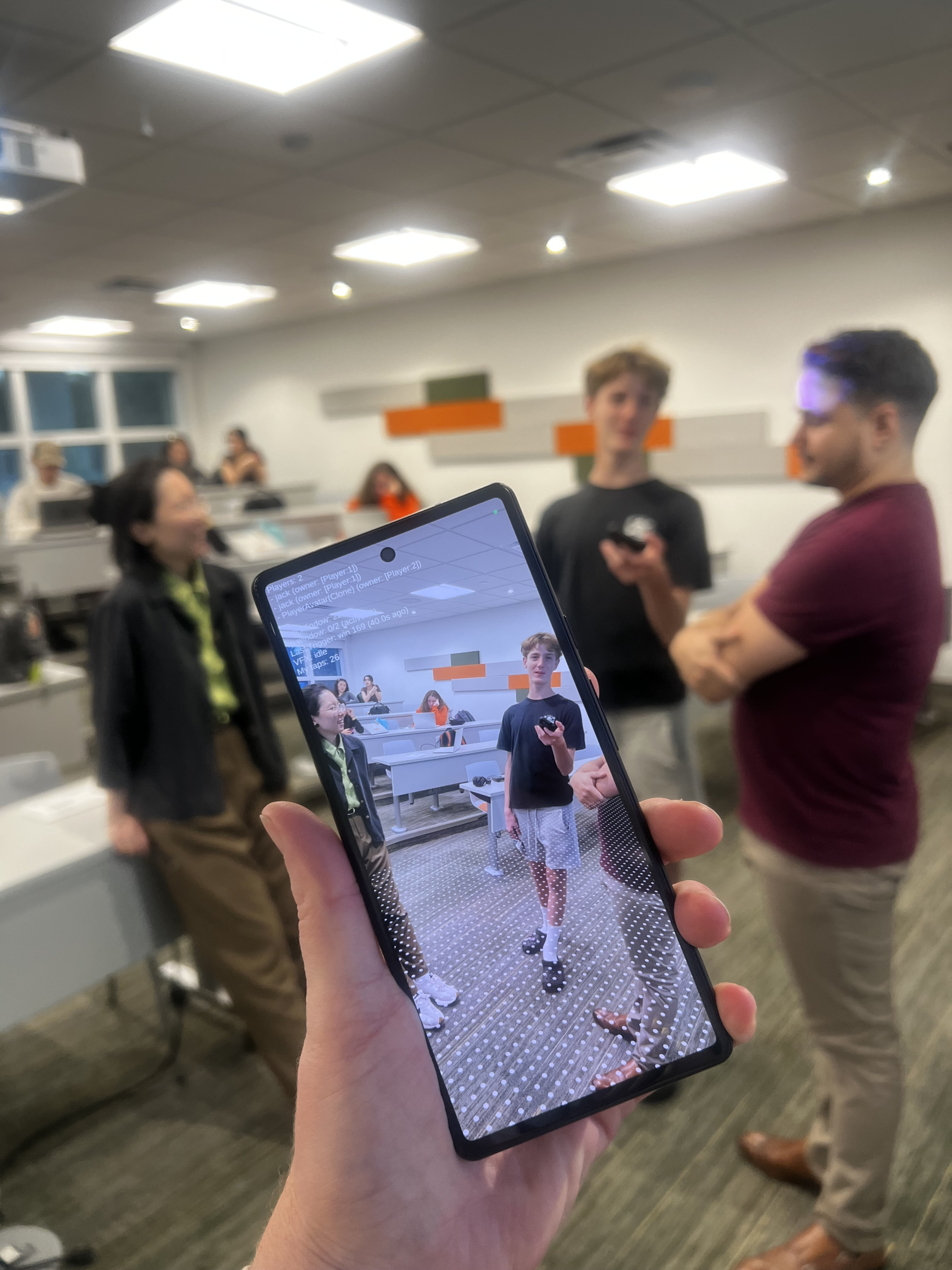
Her project uses augmented reality to recreate the atmosphere of a live concert for people who can’t physically attend. Instead of grainy livestreams or secondhand videos, Yao imagines an immersive environment where users feel present — close enough to see the stage, feel the lights, and share the moment with friends in real time.
The idea goes beyond accessibility. It considers the social aspect that makes concerts special: being with others.
“We think this could amplify the current ‘watch party’ culture,” Yao said.